

CONTENTS
Twenty pages. Four questions.
I — The Opportunity
(03–05)
02 India's EV inflection point
03 The infrastructure gap
04 An infrastructure asset, not a retail bet
II — The Model
(06–11)
05 Section · The Model
06 What FOCO actually means
07 FOCO vs FOFO vs self-operated
08 What ₹5 Lakh builds
09 The hardware
10 Investment tiers
III — The Economics
(12–16)
11 Section · The Economics
12 How a kWh becomes a rupee
13 Foundation tier · five-year model
14 Returns across all three tiers
15 Sensitivity and risk
IV — The Partnership
(17–20)
16 How we choose a site
17 Operations and technology
18 Who does what, and by when
19 Terms and next step

02
THE OPPORTUNITY
The inflection has already happened.
~6L
Electric 4-wheelers on India’s roads
+77%
Year-on-year passenger EV sales growth
4L+
Public chargers projected to be needed by 2030
Every one of those cars needs somewhere reliable to charge.
That somewhere is a physical asset, and it can be owned by you.
A BIGGER CLEANER INDIA

03
THE OPPORTUNITY
Cars are compounding.
Chargers are not.
WHAT THE GAP MEANS
≈ 9 EVs
per public charge point by 2030, even if the 4 lakh target is met in full.
≈ 75,000
charge points to be added every year, for five straight years, to get there.
Somebody funds those. The FOCO model is how you take a share of it without operating one.
04
THE OPPORTUNITY
This is infrastructure, not retail.
01
Revenue is metered, not negotiated
Every rupee is tied to a kilowatt-hour that a meter recorded. There is no inventory, no spoilage, no discounting war at the counter.
02
Demand is structural, not seasonal
EV owners do not stop charging in a slow quarter. Throughput tracks the vehicle parc in the catchment, which only moves one way.
03
Costs are known before you commit
Grid tariff, site share, maintenance and platform costs are contracted upfront. The variable that matters is utilisation, and site selection is where that is won.
04
The asset outlives the payback
A DC charger has an 8–10 year working life against an indicative payback inside 36 months. The back half of that life is the return.

05
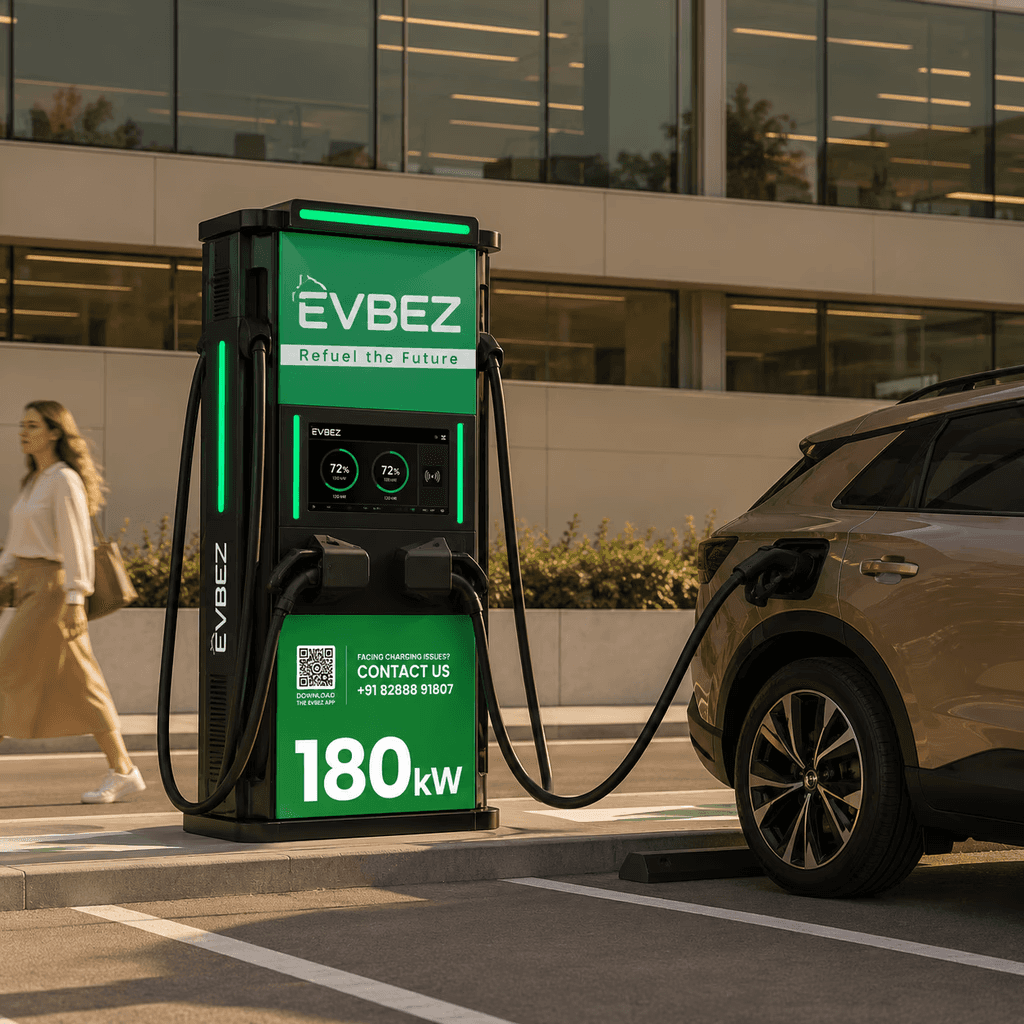
THE MODEL
Three parties.
One clean split.
YOU
The partner
Deploy capital from ₹5,00,000
Hold title to the charging asset
Optionally offer your own land
Receive a monthly payout
No staff, no licences, no operating role
EVBEZ
The operator
Site sourcing and feasibility
Supply, install and commission
Branding, app listing, marketing
24×7 monitoring and maintenance
Billing, settlement, reporting
THE DRIVER
The customer
Finds the point in the app
Charges on CCS2 at 30–120 kW
Pays by UPI, card or RFID
Rates the site, which drives repeat use
Funds the whole arrangement
HOW VALUE MOVES
01
Your capital
buys the asset
02
EVBEZ
builds and operates it
03
Drivers
charge and pay
04
Platform
meters every kWh
05
You
are paid monthly
IN ONE SENTENCE
You own a revenue-generating charging asset without ever having to run a charging station.
A BIGGER CLEANER INDIA
06
THE MODEL
Three ways to own a charger. One of them is passive.
FOCO
FOFO = Franchise Owned, Franchise Operated. Capital figures are entry points; actual project cost depends on site conditions.
07
THE MODEL
What ₹5 Lakh actually builds.
30 kW DC fast charger, CCS2, OCPP 1.6J
₹3,40,000
(68% of project cost)
Installation — civil, cabling, earthing, mounting
₹65,000
(13% of project cost)
Load sanction, metering and utility liaison
₹35,000
(7% of project cost)
Branding, signage, safety and fire kit
₹35,000
(7% of project cost)
Commissioning, CMS provisioning, onboarding
₹25,000
(5% of project cost)
ON THE GROUND
Footprint
~250 sq ft · one car bay
Power draw
3-phase, sanctioned commercial load
Connector
1 × CCS2, 30 kW DC
Enclosure
IP54, UV and water resistant
Connectivity
SIM · Wi-Fi · LAN
Payment
UPI · card · RFID
Warranty
3-year OEM, AMC thereafter

08
THE MODEL
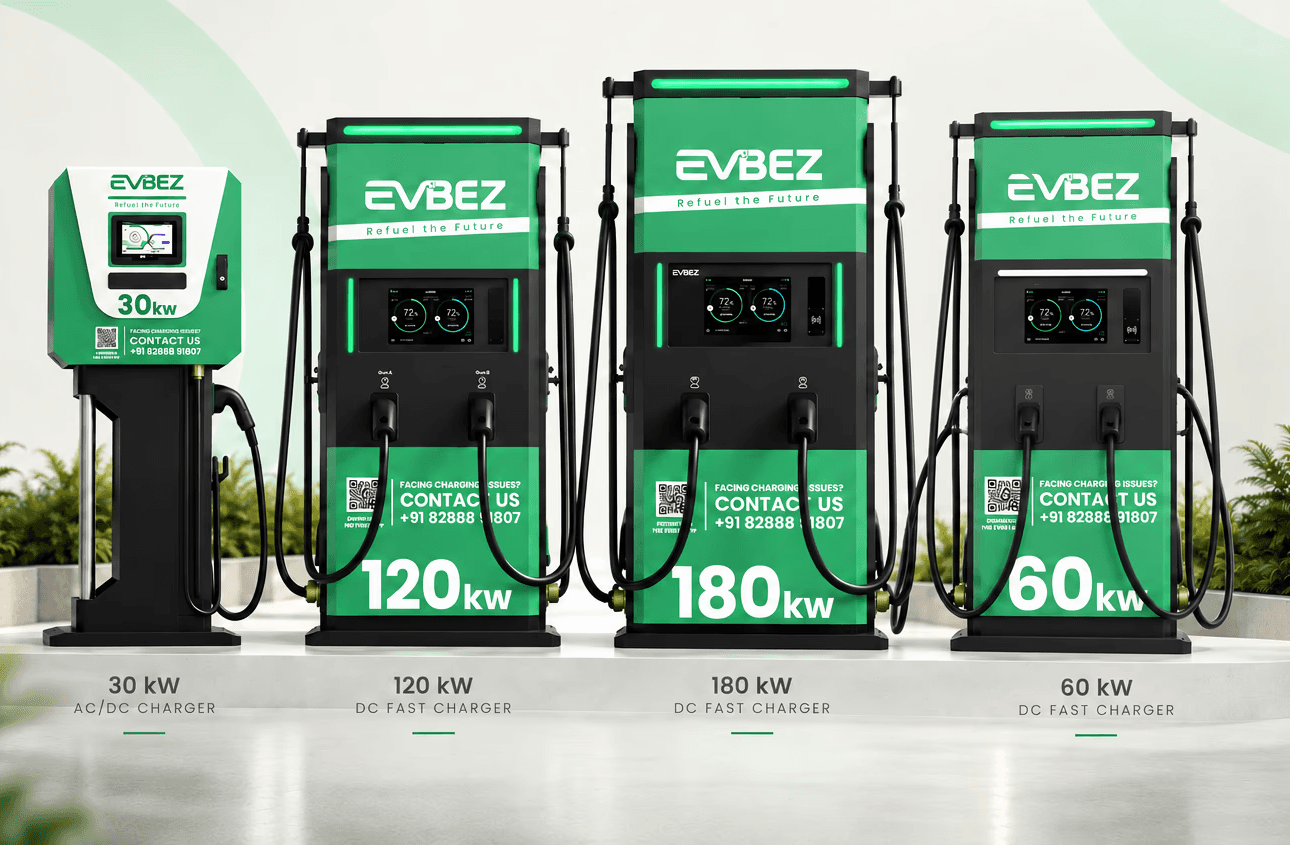
The hardware you are buying.

SPECIFICATION
Power output
30 · 60 · 120 · 180 · 240 · 360 kW
Outputs
1 or 2 guns per charger
Charging system
Dual CCS2
Upgrade path
60 kW field-upgradable to 120 kW
Connectivity
SIM · Wi-Fi · LAN
Protocol
OCCP 1.6J - open, non-proprietary
Payment
RFID · UPI · card · in-app
Enclosure
Water resistant, UV resistant exterior
Vehicles served
All CCS2 passenger EVs sold in india
Configuration supplied depends on tier and site load. Specification per EVBEZ product data, subject to change.
09
THE MODEL
Three entry points.
FOUNDATION
(Entry)
₹5,00,000
one-time, all-inclusive project cost
Charger
30 kW DC · 1 × CCS2
Space needed
~250 sq ft · 1 bay
Typical siting
Urban high-dwell, cafes, societies
Agreement term
7 years
Year-1 partner earnings
₹1.10 L
Year-3 partner earnings
₹2.10 L
5-year cumulative
₹9.89 L
GROWTH
(Most selected)
₹10,00,000
one-time, all-inclusive project cost
Charger
60 kW DC · 2 × CCS2
Space needed
~550 sq ft · 2 bays
Typical siting
Malls, office parks, arterial roads
Agreement term
7 years
Year-1 partner earnings
₹2.37 L
Year-3 partner earnings
₹4.56 L
5-year cumulative
₹21.17 L
FLAGSHIP
(Highway grade)
₹20,00,000
one-time, all-inclusive project cost
Charger
60→120 kW DC · 2 × CCS2 + 2 × AC
Space needed
~550 sq ft + canopy
Typical siting
Highways, logistics and fleet hubs
Agreement term
10 years
Year-1 partner earnings
₹4.38 L
Year-3 partner earnings
₹8.21 L
5-year cumulative
₹39.24 L
Partner earnings are illustrative projections on the assumptions set out on pages 13–16, not guaranteed returns. Actual results vary by site.

11
THE ECONOMICS
How a kilowatt-hour becomes a rupee.
YOUR CONTRACTED BASIS
₹5.00
per kWh dispensed
Paid on metered throughput, not on station profit — so operating overruns sit with EVBEZ, not with you.
Reviewed annually against the prevailing state grid tariff, within a ₹4.50–₹5.50 band.
Illustrative tariff stack. Retail tariff, grid tariff and site share vary by state and site; the figures above are the EVBEZ base case.
12
THE ECONOMICS
Three ways to own a charger. One of them is passive.
INDICATIVE PAYBACK
3 years, 1 month
Assumptions on page 16. Utilisation shown against a 30 kW × 24h theoretical maximum. Projection, not a guaranteed return.
13
THE ECONOMICS
The same shape at every ticket size.
All tiers modelled on the same ₹5.00 per kWh partner basis and the same utilisation ramp shape. Projections, not guaranteed returns.
FOUNDATION
₹5,00,000
5-year cumulative
Multiple
₹9,89,150
1.98×
Indicative payback
37 months
GROWTH
₹10,00,000
5-year cumulative
Multiple
₹21,17,000
2.12×
Indicative payback
35 months
FLAGSHIP
₹20,00,000
5-year cumulative
Multiple
₹39,23,750
1.96×
Indicative payback
37 months
14
THE ECONOMICS
What happens when the model is wrong.
Conservative
−30% throughput
5-year
₹6,92,400
Multiple
1.38×
Payback
48 mo
Base case
as modelled
5-year
₹9,89,150
Multiple
1.98×
Payback
37 mo
Upside
+30% throughput
5-year
₹12,85,900
Multiple
2.57×
Payback
30 mo
THE VARIABLE THAT DECIDES ALL THREE
Every scenario above is the same charger at a different level of use. Which is why site selection, not hardware, is where this is won.
RISK REGISTER
Utilisation falls short of the model
Site scoring before commitment; EVBEZ relocates an underperforming unit at its own cost after month 12.
₹
Grid tariff rises
Retail tariff is repriced; your basis is a ₹-per-kWh figure reviewed annually, not a share of a squeezed margin.
Hardware fails
3-year OEM warranty, AMC thereafter, spare-part SLA and remote diagnostics with auto-restart.
Technology moves on
Open OCPP 1.6J rather than a locked protocol; 60 kW units are field-upgradable to 120 kW.
You need to exit early
Asset is assignable to a third party from year 2 with consent; buy-back at written-down value available from year 3.
THE PARTNERSHIP
Charge management system
OCPP 1.6J CMS with live session data, remote start and stop, firmware push and per-connector diagnostics.
The EVBEZ driver app
Discovery, live availability, navigation, session control and digital receipts — the demand side of your asset.
Payments and settlement
UPI, card and RFID at the point; reconciled centrally and settled to you monthly.
Monitoring and response
24×7 remote monitoring with auto-restart on fault, escalating to a field visit under an SLA.
Preventive maintenance
Scheduled service visits, connector inspection, filter and fan checks, insulation testing.
Your reporting
Live dashboard access plus a monthly statement: sessions, kWh, revenue, downtime and payout.
HOW VALUE MOVES
≥97%
target network uptime
24×7
remote monitoring
Monthly
settlement, by the 7th
Live
dashboard access, always on
16
THE PARTNERSHIP
Who does what, and by when.
YOU
4 things
Deploy the capital
Complete KYC and sign the agreement
Offer a site, if you have one
Read a monthly statement
EVBEZ
10 things
Source and score the site
Negotiate the site host agreement
Apply for and secure the load sanction
Civil work, cabling, mounting, earthing
Supply, install and commission the charger
Brand the site and list it in the app
Acquire and retain drivers
Monitor, maintain and repair, 24×7
Bill, collect, reconcile and settle
Report to you every month
THE POINT
Four obligations against ten. That asymmetry is the whole product.
None of your four requires a site visit, a vendor call, an electrician, or a licence. The asset is yours; the workload is not.
Signature to first paying session: ≈60 days
SIGNATURE TO SWITCH-ON
Day 0–7
Application and site shortlist
You apply; we shortlist candidate sites in your city.
Day 7–14
Feasibility and model sign-off
Load study, site score and your project financial model.
Day 14–21
Agreement and capital
Franchise agreement executed; capital deployed to project.
Day 21–45
Sanction and civil
Load sanction, metering, civil work, cabling and mounting.
Day 45–55
Install and commission
Charger installed, tested, CMS-onboarded and safety-certified.
Day 55–60
Live
Listed in the app, soft launch, first paying sessions.
17
THE PARTNERSHIP
Terms at a glance.
OWNERSHIP
Charging asset is titled to you from commissioning.
TERM
7 years for Foundation and Growth; 10 years for Flagship.
PAYOUT BASIS
₹5 per kWh, reviewed annually within a ₹4.50–₹5.50 band.
PAYOUT DATE
Settled to your account by the 7th of the following month.
REPORTING
Live CMS dashboard access plus a monthly written statement.
TRANSFER
Asset assignable to a third party from year 2, with EVBEZ consent.
INSURANCE
Asset and third-party cover arranged by EVBEZ, carried in operating cost.
RELOCATION
EVBEZ may relocate an underperforming unit at its own cost after month 12.
NEXT STEP
Tell us your city and your ticket size.
We come back with two or three scored sites and a project model built on them.
Disclaimer — All financial figures in this document are illustrative projections built on the stated assumptions. They are not guaranteed returns, not a forecast of result, and not an offer of securities. Actual performance depends on site, utilisation, tariffs, grid conditions and regulation, and may be materially lower. Prospective partners should take independent financial, tax and legal advice before committing capital.